Proposal
03 — The feed
Every proposal, on the table.
Submissions to every Simocracy gathering, ranked by the cloth and attributed to their author sim.
loading proposals…
03 — The feed
Submissions to every Simocracy gathering, ranked by the cloth and attributed to their author sim.
June 23, 2026·by Filecoin PGF
ProPGF Batch 3ProPGF Batch 3 application. Requested: 504000. # ***High-Efficiency Infrastructure:*** * ***Only implementation with fast snapshot generation**, delivering 10x faster snapshot generation while using \~88% less RAM and \~56% less disk\*\** * ***More performant, lower-cost RPC than Lotus**, w…
Mirrored from filpgf.io — ProPGF Batch 3 (Karma program 1479, application 6a3172756e2b9bde36d202f3, status: pending). Contact details redacted; canonical application lives on filpgf.io. 1.1 Project Name Forest - an efficient and lightweight Filecoin Node 1.2 Project Github https://github.com/ChainSafe/forest/ 1.3 Project Website https://forest.chainsafe.io/ 1.4 Team Lead/Point of Contact Hubert Bugaj, Team Lead, Slack 1.5 Category [ "Core Infrastructure" ] 1.6 Open Source Status Fully Open Source 2.1 Project Summary # ***High-Efficiency Infrastructure:*** * ***Only implementation with fast snapshot generation**, delivering 10x faster snapshot generation while using \~88% less RAM and \~56% less disk\*\** * ***More performant, lower-cost RPC than Lotus**, with exclusive methods (`debug_traceTransaction`, `trace_call`) that ecosystem teams already depend on.* * ***Ecosystem cost reduction** via a scoped research effort into archival capabilities, baselining Forest's performance at archival depth, investigating nodes served from a specific chain height, and exploring more efficient archival FEVM state serving.* # ***Network Diversity:*** * ***Only source of client diversity:** Lotus and Venus are both Go with shared code and limitations; Forest is the sole Rust implementation, which has historically surfaced major protocol discrepancies across all clients.* * *Powers **2 of 4 bootstrap nodes** on both mainnet and calibnet* # ***Ecosystem Impact:*** * *Forest team co-maintains critical shared Filecoin repos including **ref-fvm / FVM, builtin-actors, go-state-types**, plus upstream `rust-libp2p`, `rust-cid`, `rust-multihash`, and others.* * *Authors protocol-level FIPs/FRCs—most notably the **new snapshot format that enabled F3 adoption**.* * *Works directly with FilOz, ChainLove, and ChainSafe Infrastructure. Cutting Forest pushes maintenance load (e.g. FVM) onto FilOz and other teams.* # ***Resource Constraints**:* * **4 seasoned protocol engineers, down from 7** after prior grant reductions. * The team is at the **forefront of agentic / AI-assisted development**; the past 6 months of output was achievable *because* these 4 engineers are already fully leveraging modern AI tooling. * Implication for decision-makers: the AI multiplier is **already priced into** current output. Headcount cannot be substituted with AI, because AI is already baked into how these 4 operate. Removing engineers removes capacity that AI cannot backfill. * Any further reduction makes it infeasible to both maintain Forest and meet existing ecosystem obligations. # ***Details*** *Forest is a Rust implementation of the Filecoin protocol. It provides a lightweight, high-performance alternative to Lotus. It is essential for ecosystem services, including snapshot providers and RPC providers.* *This grant enables ongoing Forest maintenance and broader adoption across ecosystem teams. It also funds a scoped research effort into archival capabilities to further reduce ecosystem costs. Rather than committing to full chain archival, where the cost-benefit versus Lotus is unproven, this work will baseline Forest's performance at archival depth and investigate serving nodes from a specific chain height, a capability particularly valuable to infrastructure providers. It will also explore more efficient archival FEVM state servin …[truncated] 2.2 Who does this work support? [ "Network Infrastructure", "Application Users", "Application Builders" ] 2.3 Total Funding Requested (USD) 504000 2.4 Milestones & Budget [ { "title": "Milestone 1", "description": "Ongoing development and long-term maintenance of the Forest Filecoin node to ensure protocol correctness, stability, and compatibility with the Filecoin network.\n\nTimely implementation of all mandatory Filecoin network upgrades in Forest in line with the published network upgrade schedule.\n\nProactive bug fixing, security patches, and regression prevention to maintain production-grade reliability.\nContinuous performance improvements to reduce CPU, memory, and operational requirements for infrastructure providers.\nSupport for Filecoin protocol evolution through Forest implementations of approved FIPs and FRCs, and participation in protocol design discussions.\n\nDevelopment-driven improvements to shared protocol components, where required, to maintain Forest correctness and network compatibility.", "dueDate": "2026-12-31", "fundingRequested": "252000", "completionCriteria": "N/A" }, { "title": "Milestone 2", "description": "Ongoing development and long-term maintenance of the Forest Filecoin node to ensure protocol correctness, stability, and compatibility with the Filecoin network.\n\nTimely implementation of all mandatory Filecoin network upgrades in Forest in line with the published network upgrade schedule.\n\nProactive bug fixing, security patches, and regression prevention to maintain production-grade reliability.\nContinuous performance improvements to reduce CPU, memory, and operational requirements for infrastructure providers.\nSupport for Filecoin protocol evolution through Forest implementations of approved FIPs and FRCs, and participation in protocol design discussions.\n\nDevelopment-driven improvements to shared protocol components, where required, to maintain Forest correctness and network compatibility.", "dueDate": "2027-03-31", "fundingRequested": "252000", "completionCriteria": "N/A" } ] 3.1 Impact pathway Forest is a core infrastructure project. Running Forest enables cost reductions for RPC providers, DEXes, and other ecosystem services while improving performance. This impacts all objectives very indirectly, but it’s not immediately visible. It also enables all nodes to join the network more quickly, thanks to more up-to-date snapshots. The team’s impact also goes beyond the Forest client; Forest engineers are involved in maintaining other core Filecoin repositories and regularly work on improving the ecosystem. 3.2 Verification metrics | Metric | Data source | How it's measured | Target (end of grant) | | :---- | :---- | :---- | :---- | | Forest successfully implements and releases support for 100% of mandatory Filecoin network upgrades in collaboration with other node implementations during the grant period within the scheduled upgrade windows. | Public GitHub releases and release notes | *\-* | *Grant period* | | Forest consistently demonstrates lower memory and CPU consumption compared to Lotus for defined non-mining infrastructure roles, including RPC, bootstrap, and snapshot generation, enabling production deployment on lower-spec hardware while delivering higher performance. | Both internal and ecosystem measurements | *\-* | Grant period | | The Forest Faucet operates as a reliable, publicly accessible developer access infrastructure for Filecoin mainnet and test networks throughout the grant period. | Publicly available source code, documentation, and issue tracking reflecting ongoing stewardship and attentive maintenance of the Forest Faucet. | | Grant period | 3.3 References - ChainSafe Infrastructure - running 2 bootstrap nodes, both archival and latest snapshot operations for the past 3 years. - ChainLove - Forest team and ChainLove have been working together for several months to improve RPC performance for users, all that while reducing costs. - FilOz - FilOz team and Forest have been collaborating for several years already on improving the Filecoin ecosystem. 4.1 Monthly Operating Burn [ "$10-$100K (small team)" ] 4.2 What % of total team monthly burn depends on this grant? 100 4.3 If this grant is not awarded, what happens? ***Executive Summary*** * Forest archived after Sept 2026; **stops syncing at the next network upgrade**.* * Snapshot generation costs and times spike; **archival snapshots need a replacement or chain data is permanently lost**.* * RPC-dependent teams forced onto Lotus at higher cost; Forest-exclusive RPC methods blocked unless reimplemented elsewhere.* * Both faucets lost (no mainnet alternative); FVM and other Filecoin-core repositories co-maintenance ends.* * The **ChainSafe Infrastructure Filecoin grant becomes unfeasible**, since it is only sustainable thanks to Forest's low hardware requirements.* *ChainSafe will continue maintaining Forest until the end of the ProPGF Round 2 grant (end of September 2026). Afterwards, the project and other supporting repositories will be archived. Users will be able to run Forest until the next network upgrade; afterwards, Forest will stop syncing. The Forest Explorer faucet will be deactivated.* *The cost of generating snapshots will increase significantly, as will the time to generate them. This will increase the operational costs of infrastructure teams and their SLOs. Both archival and latest snapshots will be affected; the former will need a replacement in the ecosystem to prevent permanent chain data loss. They can be generated with Lotus, although with much more expensive hardware and several times slower.* 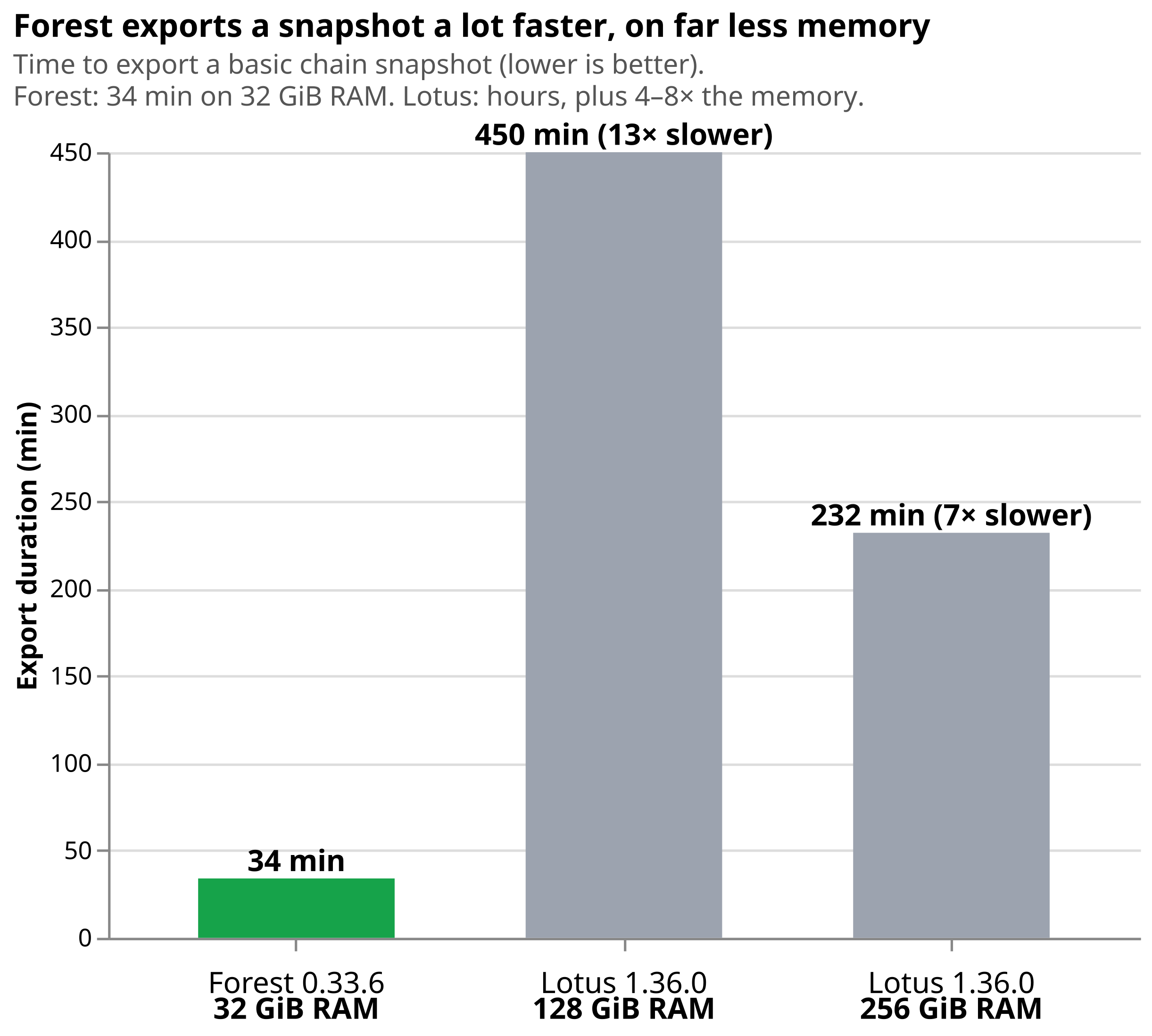 *Teams that depend on Forest as an RPC node will need to migrate to Lotus, which will increase operational costs. Projects using Forest-exclusive RPC methods, such as `debug_traceTransaction` and `trace_call`, will be blocked unless FilOz implements them in Lotus.* *Similarly, SynapseSDK from FOC will need to migrate from Forest Explorer to a different calibnet tFIL and tUSDFC provider if one exists. The mainnet faucet would be lost, as there’s no available alternative.* *Co-maintenance of several central and critical Filecoin Project repositories, including FVM, will be discontinued, increasing the FilOz and other teams’ workload.* *Finally, bootstrap nodes will need to be migrated to Lotus or Venus, increasing the operational costs.* *To emphasise further, infrastructure costs will rise significantly, including for snapshot handling, RPCs, and bootstrap provisioning. The current ChainSafe Infrastructure grant for Filecoin services will become unfeasible, as it is only sustainable with Forest's lower hardware needs. ChainSafe Infrastructure also benefits from direct feedback with Forest engineers, which helps operations.* 4.4 Core Team - Hubert Bugaj, team & tech lead. Working on the Forest project since 2022. - Hailong Mu, principal software engineer. Working on the Forest project since 2023. - Shashank Prasad, software engineer. Working on the Forest project since 2023. - Aryan Tikarya, software engineer. Working on the Forest project since 2025, in the Filecoin ecosystem since 2024. 4.5 Has your team received a ProPGF grant or funding from PLFIF before? [ "Yes" ] 5.1 Key risks & dependencies ## Grant-capping The project-based grant model limits the scope of protocol maintenance work that can be delivered within a fixed budget. During the grant period, there are concrete requests and expectations from ecosystem stakeholders (including Filecoin Foundation and protocol-adjacent teams) that fall outside the feasible scope of a capped ProPGF grant and therefore cannot be guaranteed under this funding model. ## Grant reduction In the past the team consisted of 7 team members. Over the past year the capacity was reduced to 4 team members due to grant reductions. While we are aligned to keep the ecosystem cost-effective, we need to state that further reductions would make it unfeasible to both maintain Forest and keep other obligations to the Filecoin ecosystem. Having fully embraced AI-assisted tooling to maximize output per engineer and offset the earlier reduction in headcount, the current team is now operating at top capacity, with no further efficiency gains available to absorb additional cuts. Anything else you want to share that we didn't ask? ***Snapshot generation*** *Forest is essential for timely and efficient network snapshot generation. While it is possible to generate a snapshot with Lotus, it’s significantly more expensive and slower. Below table compares a basic snapshot export across implementations.* | | *Required disk space \[GiB\]* | *RAM \[GiB\]* | *Export duration \[minutes\]* | | :---- | :---- | :---- | :---- | | ***Forest*** | ***200*** | ***32*** | ***34*** | | ***Lotus*** | ***450*** | ***128*** | ***450*** | | ***Lotus*** | ***450*** | ***256*** | ***232*** | *Note: Lotus snapshots are also not compressed; Forest does it under the hood. Both implementations are able to consume compressed snapshots. This significantly reduces the cost of storing snapshots. While it’s possible to compress the snapshot after it’s been generated, it would increase the operation duration even further.* ***Efficient RPC node*** *Forest has also proven to be an efficient RPC node alternative to Lotus. The carts below showcase Forest’s performance relative to Lotus. The measurements were done with real RPC provider traffic.* 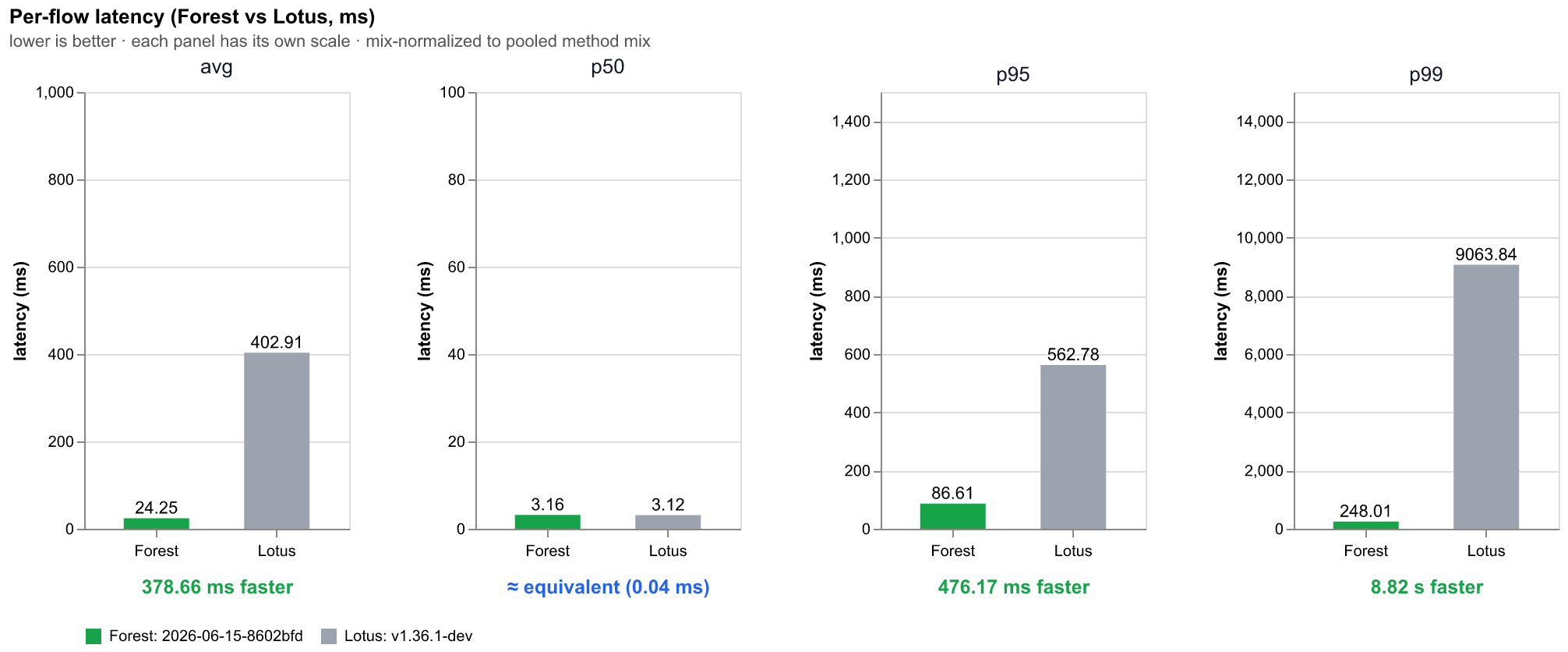 *Forest delivers faster average response times and a substantial reduction in worst-case latency (P95 and P99). The slow outliers that most affect reliability are now far less common, giving users a more consistent and predictable experience. Median response P50 is on par with Lotus, which indicates some room for improvement.* 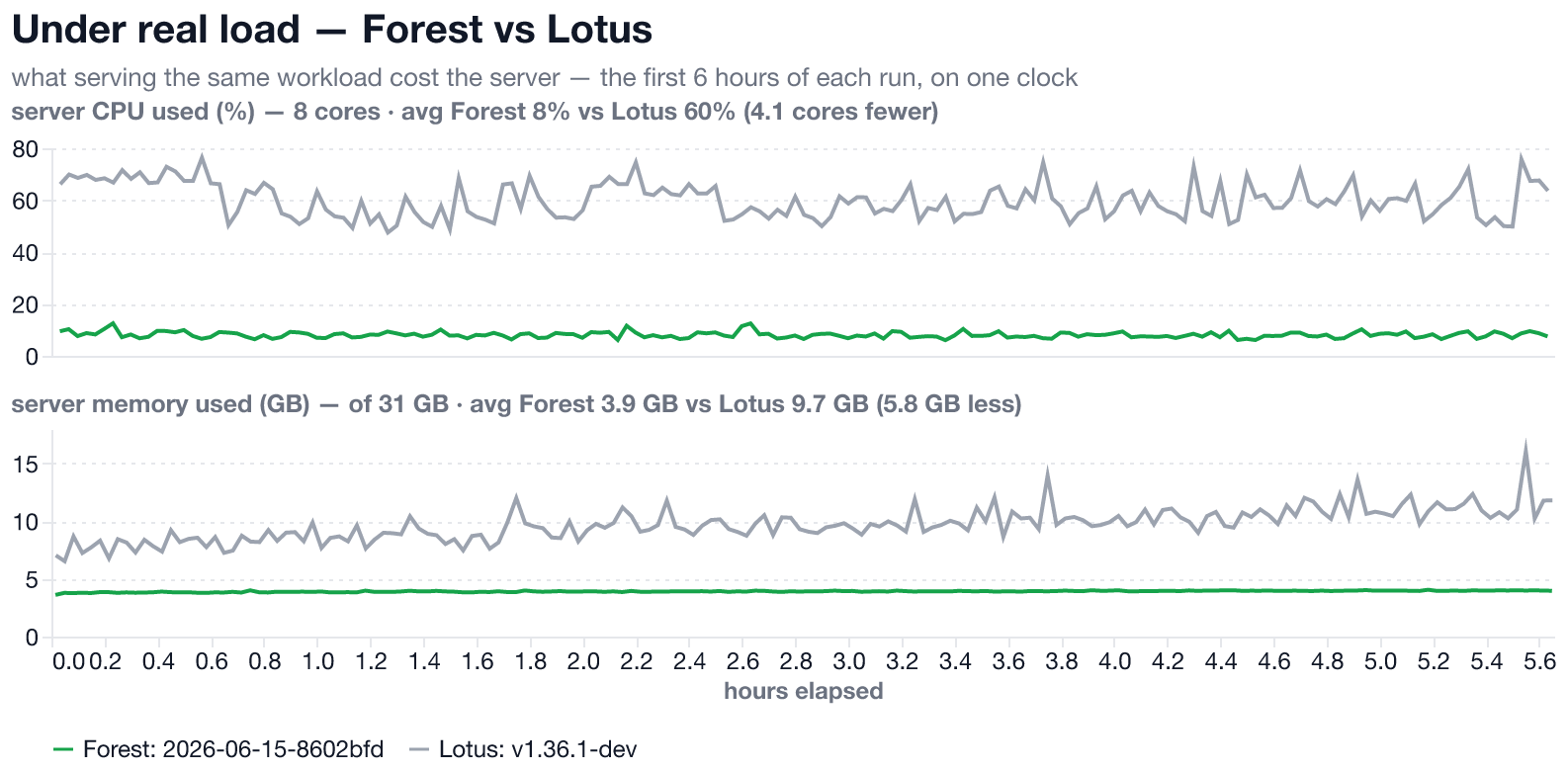 *At the same time, a Forest node uses less resources and shows smoother load on the machine. Note that the nodes actually use more memory (page caches), but the proportions are still correct.* *With all that said, some individual RPC methods’ performance still needs to be improved so that we can claim that Forest outperforms other solutions on every method.* *To further strengthen aforementioned points, the charts below represent measurements taken by one of the recognized RPC providers in their own dedicated infrastructure, with a slightly different overall setup.* 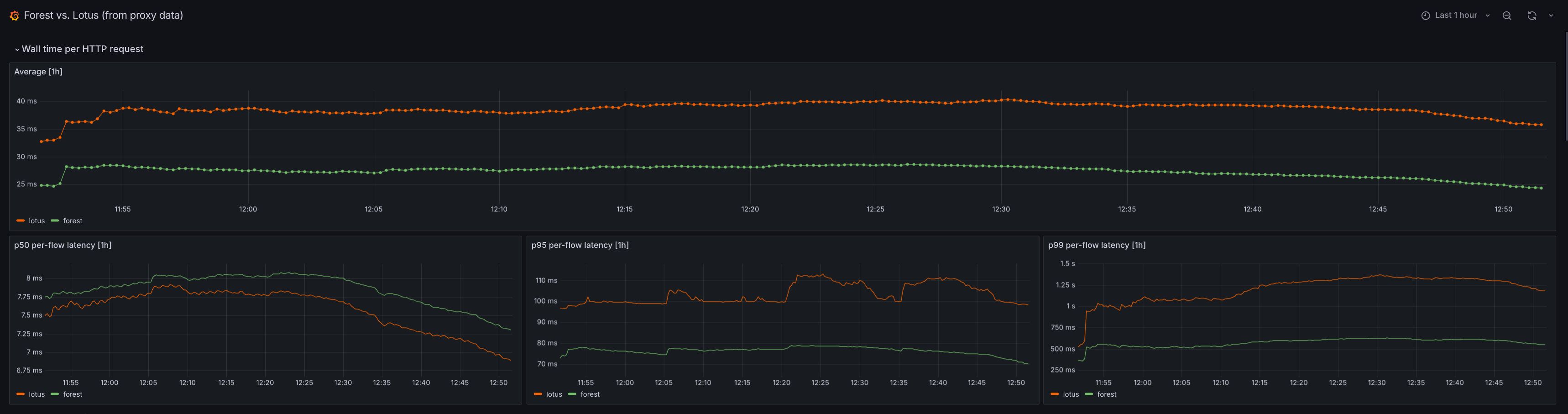  ***List of Forest-team maintained repositories:*** *Forest: https://github.com/ChainSafe/forest* *Forest Faucet: https://github.com/ChainSafe/forest-explorer* *Ref-fvm: https://github.com/filecoin-project/ref-fvm* *Rust-F3: https://github.com/ChainSafe/rust-f3* *Fil-actor-states: https://github.com/ChainSafe/fil-actor-states* *Built-in actors: https://github.com/filecoin-project/builtin-actors* *Forest regularly posts updates around its development, both inside and outs …[truncated] Contributing to Core Infrastructure? Forest powers two out of four bootstrap nodes on the network, both in the calibration network and the mainnet. It is the only implementation that enables fast snapshot generation, which is essential for joining the network. Forest has lower resource requirements along with performant ETH RPC compared to Lotus, making it more attractive to infrastructure providers supporting Filecoin and for practical EVM compatibility at the RPC level. Ongoing discussions with leading block explorer teams indicate growing adoption. Several ecosystem teams have already migrated to Forest to access its exclusive RPC methods and more cost-effective operations, demonstrating wider adoption across multiple services. Karma Profile 0x16bc3ee698d158aec7d1931c0254d4f7736aa300ddf64615348f9e4b30e4bb2a Objective 1 N/A Objective 2 Indirect Objective 3 N/A Open Source Context All Forest code is open source, and Forest team members regularly contribute to and help maintain other open-source repositories, both in the Filecoin ecosystem and beyond. Those include (just in the past 3 months): # Filecoin project - filecoin-project/lotus - filecoin-project/ref-fvm - filecoin-project/rust-fil-proofs - filecoin-project/rust-filecoin-proofs-api - filecoin-project/builtin-actors - filecoin-project/builtin-actors-bundler - filecoin-project/go-state-types - filecoin-project/bellperson # libp2p / multiformats / IPLD - libp2p/rust-libp2p - multiformats/rust-cid - multiformats/rust-multihash - ipld/serde_ipld_dagcbor
Sign in to comment.